

A single failed cartridge sump housing cost one dealer more than $480,000. He had no leak prevention on the system. If you sell, install, or service water-using equipment, that number is your problem too — and the insurance market has already noticed.
The claim that should worry every dealer
A client of ours in British Columbia was asked to pay over $480,000 toward a water damage claim after a cartridge sump housing failed. There was no leak detection and no automatic shut-off anywhere on that system. By the time anyone knew there was a problem, the damage was done.
That is the extreme end of the scale, but the pattern behind it is ordinary. Water filtration products, and the plumbing fittings that connect them, can leak or fail over time — often after repeated maintenance and service calls. Every housing, every fitting, every tubing run you install is a component that will eventually be opened, re-seated, and closed again by somebody. Each of those cycles is a chance for a slow leak to start behind a cabinet where nobody is looking.
We have heard from peers in the trade who were told they would no longer be insured following a serious water damage claim. Whether that decision came from claim frequency or from the sheer expense of a single claim almost does not matter. The outcome is the same: a water treatment business that suddenly has very few options for coverage, in an industry that carriers have come to regard as high risk precisely because it involves products that hold water under pressure.
What the claims data says
The figures below come from the insurance and industry sources cited, gathered for presentations we delivered in 2020 and to the CWQA in October 2023. They are point-in-time numbers, not live statistics, and several are Canada-specific — but the direction they describe has not reversed.
- Water damage is the second most frequent home insurance claim, behind weather and wind damage — and it is claimed more often than fire. By cost, the largest carriers have reported it as the third highest claim.
- Water damage accounts for roughly 50% of home insurance claim costs in Canada. (Canadian Underwriter Insurance Guide)
- 26% of more than 3,000 survey respondents reported at least one water damage incident in their home. (Desjardins Group, via Canadian Underwriter)
- The average water damage claim cost was $16,070 in 2014, and claim costs in British Columbia rose 84% over the preceding decade. (Park Insurance)
- Since 2015, water damage claims in Canada increased by over 50%. (Canadian Underwriter)
- About 93% of water damage is preventable — yet 43% of homeowners surveyed had no idea how to prevent it. (Arguello Hope; Desjardins Group)
That last pairing is the whole argument in two lines. Almost all of this damage can be stopped, and almost half the people living with the risk do not know that the technology to stop it exists. That gap is not a consumer problem. It is a sales opportunity, and it is a liability exposure, depending entirely on whether you bring it up.
Where the leaks actually come from
Homeowners tend to picture a burst pipe in a wall. The more expensive reality is usually slower and duller:
- Toilets — 48% of leaks
- Broken pipes — 15% of leaks
- Faucets — 10% of leaks
And the volumes add up faster than most customers believe. On average, 12% to 14% of the water entering a home is lost to leaks — the EPA has averaged this at roughly 10,000 gallons per home, per year. A faucet dripping once per second wastes about 3,000 gallons in a year. A 1/8″ crack in a pipe can release 250 gallons in a single day. And 75% of water heaters fail before they are 12 years old.
None of those events announce themselves. They are found either by a monitoring device or by a restoration contractor.
Why this lands on the trade, not just the homeowner
Ask yourself what happens to your commercial policy if a water leak originates from a product you sold, installed, or simply serviced. Not only can your premiums rise on claim liability — you may find yourself declined by your existing insurer and then discover there are few alternatives willing to write a water treatment business at all.
It has been suggested to us that the industry protect itself with disclaimers and signed waivers between dealer and consumer. We would rather go the other way: explain the benefit of prevention devices, and install them. A waiver is an argument you have after the damage. A shut-off valve is a claim that never happens.
There is a commercial upside as well. Most carriers now recognize leak prevention and water flow termination devices as legitimate safety equipment, in the same category as smoke detectors and monitored alarms — which means leak detection can help your customer on their premium, not just on their risk.
Two layers of protection
Leak prevention is not one product. In practice it is two layers, and a well-protected home has both.
1. Whole-home monitoring and automatic shut-off
A control plumbed in at the point of entry, after the main valve and any pressure reducing valve, ideally ahead of every line you want monitored. It watches flow 24/7, learns the property’s normal usage pattern, and closes the water supply when it sees a failure event — whether or not anyone is home.
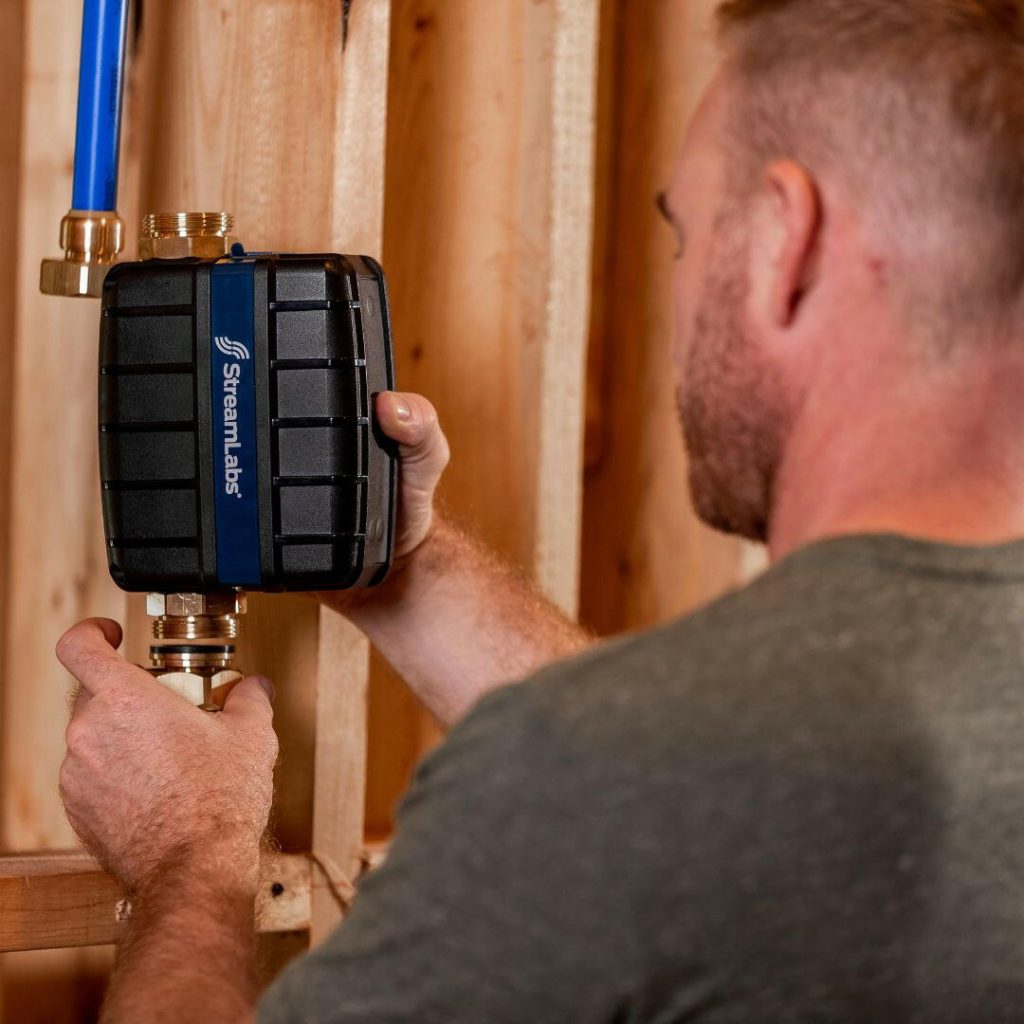
The StreamLabs Control uses ultrasonic flow measurement to detect flow as low as 0.1 GPM, through a full-flow 1″ lead-free brass body with a stainless steel ball valve. It carries NSF 61 and NSF 372 certification along with CSA and UL listings. Onboard pressure, temperature, and humidity sensors add freeze warnings and mold-risk alerts, and a daily Drip Detect check catches pinhole leaks below the flow meter’s threshold. It is Wi-Fi enabled but not Wi-Fi dependent — if the connection drops, the unit keeps monitoring and can still shut the water down. Connections are available in FNPT or SharkBite push-connect, in 3/4″, 1″, and 1-1/4″.
The Flo by Moen Smart Water Monitor & Shutoff covers the same job with its own MicroLeak™ daily plumbing test, proactive alerting, and remote shut-off, in 3/4″, 1″, and 1-1/4″ sizes.
Worth noting on the insurance question: Chubb — among the largest carriers in North America — acquired StreamLabs outright. Carriers are not waiting for this technology to prove itself. They bought it.
2. Point-of-use protection at the equipment
Whole-home protection does not remove the need for a catch at the appliance, and for under-sink RO and filtration work the point-of-use device is often the one that saves you. These are inexpensive, they install in minutes, and they are the single cheapest liability reduction available on a filtration install:
- Leak Detector with Tray (LDT14) — a mechanical drip tray with a cotton pad that swells on contact with water and closes the feed water valve. No batteries, nothing to fail electronically, and a larger detection area than a bare sensor. Available with the tray or as the detector alone in 1/4″ or 3/8″ QC.
- Leak Block Sensor (LBS-10) — a battery-powered sensing pad and latching solenoid valve with a low battery alert. At end of battery life the solenoid latches closed as a failsafe, so the failure mode is “water off,” not “water on.”
- Leak Detector (LD-38-JG) — automatic supply shut-off with low battery warning.
Our position is straightforward: every under-sink and whole-home system should have leak detection monitoring or an automatic shut-off. The liability potential without one is significant for dealers and distributors alike.
How to raise it with a customer
Promoting this can feel awkward if you have not done it before, so keep it factual and let the customer decide:
- Lead with the equipment, not with fear. “This system holds water under pressure and gets opened every time it’s serviced. Here’s what we put on it so a fitting failure doesn’t become a renovation.”
- Use their insurer. Many carriers now discount for leak prevention. Tell customers to ask — it reframes the device as something that pays them back.
- Quote the preventability number. 93% of water damage is preventable. Most people have never heard it.
- Make it standard, not optional. Attach point-of-use protection to every filtration quote by default. A line item the customer declines in writing is a very different conversation than one you never offered.
- Cover the absent-owner case. Vacation homes, rentals, and seasonal properties are where an undetected leak runs longest — and where remote shut-off is worth the most.
The short version
Water damage is more frequent than fire, expensive when it happens, and overwhelmingly preventable. The technology is proven, affordable, and quick to install. Insurers are actively rewarding it. And the professionals most exposed to a bad claim are the ones who handle water equipment for a living.
We all have a responsibility to help mitigate water leak liability — for the consumer, and for each other. Leak prevention is the answer.
See the full leak prevention line — StreamLabs, Flo by Moen, and point-of-use detectors — on our Featured Products page. Call for pricing or to order; our office numbers are at the bottom of every page.