

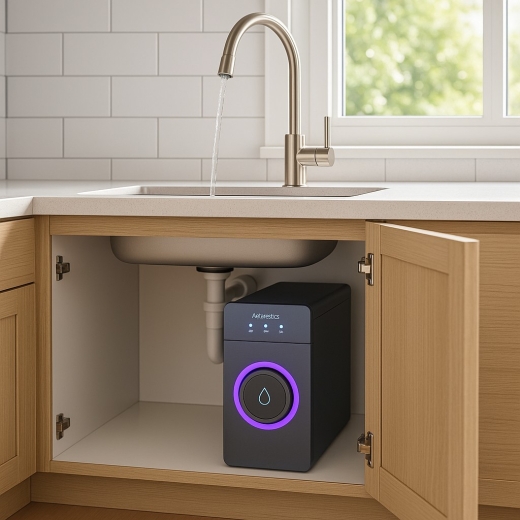
The storage tank is the biggest object in the cabinet, the slowest part of the system, and one more vessel sitting under pressure beneath somebody’s sink. The Azuretics tankless line takes it out of the equation — 600 GPD nominally rated, produced on demand.
The tank was always the compromise
A conventional under-sink RO system spends most of its life not making water. It fills a bladder tank slowly, the customer draws off a glass, and the system starts again. That design works, and it has sold for decades — but every installer reading this knows what it costs:
- The tank owns the cabinet. A 3–4 gallon bladder tank is the single largest component you put under a sink, and it is the one the homeowner notices when they can no longer fit their cleaning supplies.
- Stored water is not fresh water. Product sits against the bladder between draws, and TDS creeps up the longer it sits.
- Recovery is slow. Draw down the tank at a dinner party and the customer is waiting on it.
- It is another thing that fails. Waterlogged bladders, failed tank valves, and the fittings that connect them are all callbacks — and they are all pressurized connections in a cabinet nobody looks inside.
Tankless RO removes that component entirely. The membrane produces water at the moment of demand instead of filling a reservoir against it.
Two models, two service profiles
Azuretics offers the tankless platform in two configurations. Both are nominally rated at 600 GPD and both accept a maximum incoming TDS of 1,000 ppm. The practical difference is how many elements you handle on a service call.
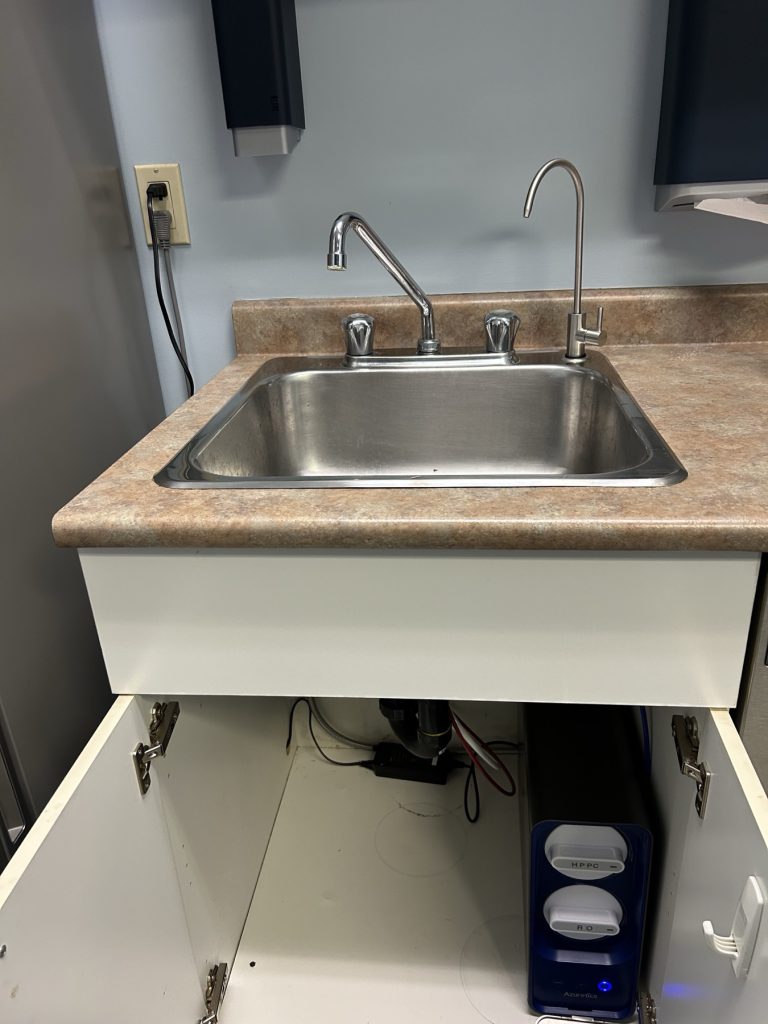
2 in 1 — Model 83802
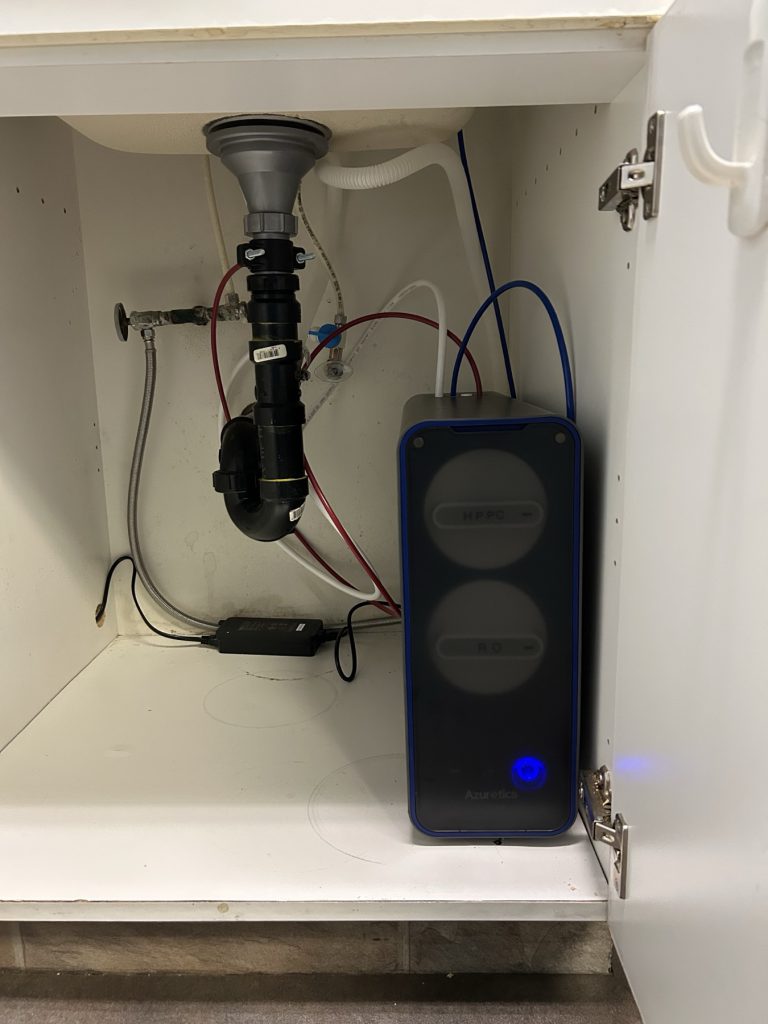
- 4-stage filtration within 2 elements — an HPPC cartridge and the RO membrane, each on its own quick-turn cap
- 600 GPD membrane
- 17″ H × 14″ W × 5.5″ D
- Filtered and/or RO water dispensing, with a dual faucet option available
- Replacement cartridge 71156 · replacement membrane 71157
Separating the cartridge from the membrane is the useful part here. Prefilter life and membrane life are not the same, and this model lets you change the one that is actually spent instead of throwing away good membrane with a loaded carbon block.
5 in 1 — Model 85610
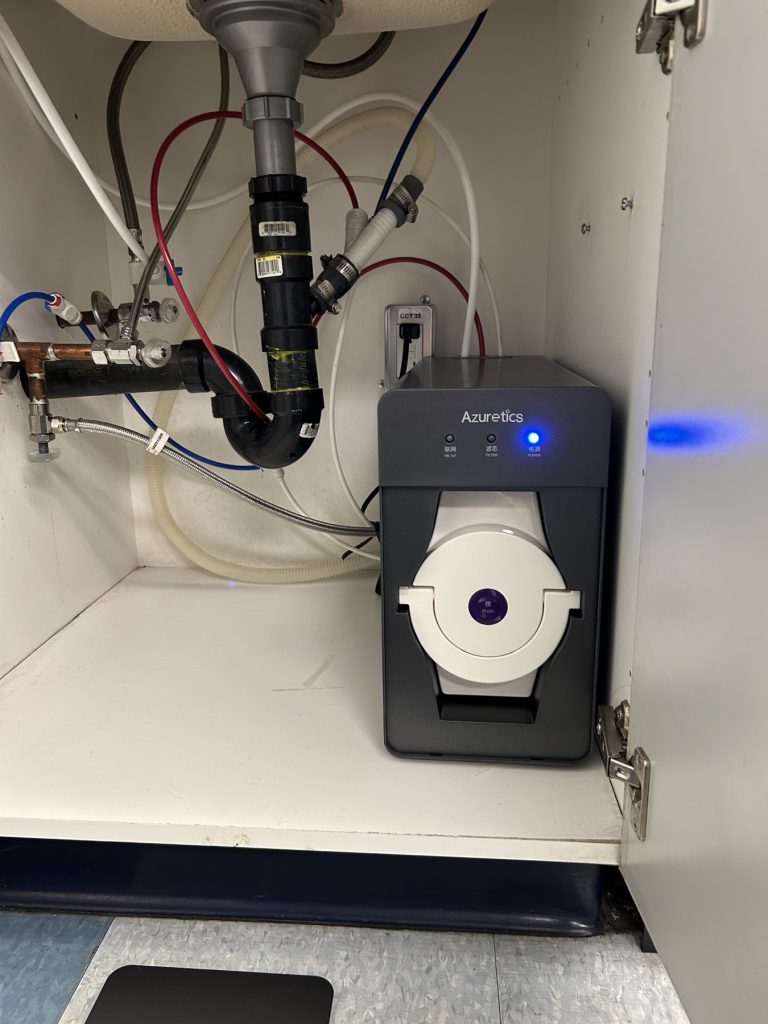
- 5-stage filtration within a single element
- 600 GPD nominally rated membrane
- 16.5″ H × 12″ W × 6.5″ D
- Single quick-turn change out
- Replacement cartridge/membrane 71158
This is the one to quote when the service call matters more than consumable cost. One part number, one twist, done — which is a genuinely different proposition when you are routing a technician through a day of filter changes, or when the customer intends to do it themselves.
What it actually produced
The figures below are the manufacturer’s performance specifications, measured in Alberta, Canada at an average water temperature of 15 °C. Membrane output moves with temperature and pressure, so treat these as a benchmark from a stated condition rather than a guarantee for your customer’s basement.
| Incoming TDS | 227 |
| Product TDS | 7 |
| Rejection rate | 96.9% |
| Production volume | 1.5 L / 0.4 GPM in 63 sec |
| Waste volume* | 1.4 L / 0.37 GPM in 63 sec |
| TDS at start-up, and time to settle | 72 → 11 TDS in 45 sec |
| Projected daily production @ 15 °C | 542 gallons |
| Operating voltage | 24V DC |
| Operating pressure | 25 PSI minimum · 87 PSI maximum |
*Waste volume includes a fast flush that occurs immediately after drinking water is dispensed.
Two numbers there deserve a second look.
Recovery is roughly one to one. 1.5 L of product against 1.4 L of waste — and that waste figure already includes the post-dispense fast flush. Set that against the 3:1 and 4:1 ratios customers may have heard about traditional RO and it becomes a talking point, particularly anywhere water is metered or scarce.
There is a start-up TDS curve. The first water out of the system reads 72 TDS and settles to 11 within 45 seconds. That is normal behaviour for direct-flow RO, but it is worth telling the customer during commissioning — otherwise the first person to put a TDS meter under the faucet will call you.
What to confirm before you quote
Nothing here is difficult, but all of it is easier to check before the truck is loaded:
- Power at the cabinet. These run on 24V DC through a supplied adapter, which means a receptacle under the sink. Plenty of older kitchens do not have one, and that is an electrician, not a plumber.
- Line pressure between 25 and 87 PSI. Below the minimum it will not perform; above the maximum you need a pressure reducing valve.
- Incoming TDS at or under 1,000 ppm. Test first.
- The install kit is not included. Order it with the system rather than discovering it on site.
- Microbiologically safe water only. This is a treatment system, not a disinfection system.
- Storage, if they want it. A bladder tank can still be added for additional storage or higher pressure applications — the tankless design does not forbid it, it just no longer requires it.
Fewer components, but not zero risk
Taking the tank out removes a pressurized vessel and its fittings from the cabinet, and fewer connections genuinely does mean fewer places for a slow leak to start. We would still put leak protection on it.
Every under-sink system gets opened on a service call, and every fitting gets re-seated eventually. A drip tray with an automatic shut-off costs very little against the callback it prevents — and against the liability a water damage claim puts on the dealer who did the install. That argument is the same one we made about leak prevention on every system you install, and a tankless RO does not exempt you from it.
Where it fits
Tankless RO is the straightforward upgrade sell: the customer gets their cabinet back, water that has not been sitting in a bladder, and no waiting on tank recovery. You get a shorter install, a simpler service call, and one less component to warranty.
For most residential work the 5 in 1 is the easier system to own. Where the customer wants filtered and RO water at separate taps, or where you would rather change prefilter and membrane on their own schedules, the 2 in 1 is the better fit.
Azuretics tankless RO — 2 in 1 (83802) and 5 in 1 (85610), with replacement elements 71156, 71157, and 71158. Call for pricing or to order; our office numbers are at the bottom of every page. More articles on the Water Treatment Insight blog.